Navigating the Legal and Policy Complexities of AI-Authored Books in 2026
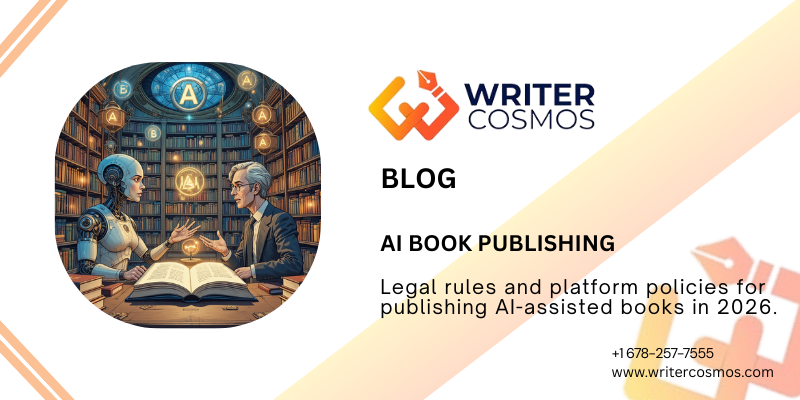
The rapid evolution of generative artificial intelligence has created unprecedented opportunities and challenges in the publishing industry. Authors, publishers, and platforms must now grapple with fundamental questions about authorship, ownership, transparency, and accountability. As of February 2026, the central question remains: can you publish AI-written books? The answer is yes, but only within strict legal, platform, and ethical boundaries that every creator must fully understand to avoid serious consequences.
Writer Cosmos has conducted extensive ongoing analysis of regulatory updates, court rulings, platform policies, and industry practices to deliver this authoritative legal and policy guide. Our mission is to equip authors with clear, accurate, and actionable information so they can make responsible decisions in this fast-changing environment.
How to Publish an AI-Written Book Legally
The Human Authorship Requirement
United States copyright law is built on the principle that protection applies only to original works of human authorship. The U.S. Copyright Office has repeatedly and consistently upheld this requirement across multiple official reports and registration decisions issued between 2023 and early 2026.
In its comprehensive Part 2 report released on January 29, 2025, the Copyright Office concluded that the current law is sufficient and does not require immediate legislative overhaul. The Office stated clearly that material produced by an AI system without meaningful human creative control does not qualify for copyright protection. Prompts, no matter how detailed or refined through multiple iterations, do not meet the threshold of human authorship. Copyright protects the original expression that results from human creative choices such as selection, arrangement, substantial modification, or integration into a larger work.
How the Copyright Office Actually Processes AI-Related Applications
When submitting an application (Form TX for literary works), authors must complete the “Author Created” field describing their contribution and the “Material Excluded” field listing any AI-generated portions excluded from the claim. The Office has published refusal letters that provide insight into their reasoning. Common refusal language includes: “The work lacks the human authorship required for copyright protection” or “The applicant’s role was limited to prompting the AI system.”
In practice, examiners review the deposit copy alongside the application description. If the human contribution appears minimal (e.g., only prompts and minor tweaks), registration is denied. Applicants can request reconsideration, but success is rare without additional evidence of creative control.
Derivative Works and AI: When Editing AI Output Becomes Copyrightable
A key pathway to protection involves treating AI output as a starting point and creating a derivative work. To qualify, the human edits must meet the threshold of originality, a low bar, but not zero. Rearranging sentences, changing wording, adding original chapters, or infusing a unique style can suffice. The Copyright Office has registered works where authors started with AI drafts and then performed extensive rewriting, curation, and creative restructuring.
Writer Cosmos analysis of successful registrations shows that authors who document at least 40–60% original expressive content (measured by word changes, structural additions, and thematic development) have the strongest claims.
Training Data Lawsuits and Potential Secondary Liability
Ongoing high-profile litigation (e.g., Getty Images v. Stability AI, The New York Times v. OpenAI, and Authors Guild class actions) centers on whether AI companies infringed copyrights by using protected works to train models. If courts rule that outputs containing substantial similarities to training data are infringing, individual publishers could face secondary liability claims, especially if they knew or should have known the content was derived from copyrighted material.
While most individual authors are low-risk targets, large-scale publish chatgpt book operations or those using models known to reproduce protected text face elevated exposure. As of February 2026, no final rulings have been issued in these major cases, but preliminary decisions have allowed many suits to proceed to discovery.
Amazon KDP’s Official AI Disclosure Policy
Definition of AI-Generated vs AI-Assisted Content
Amazon operates one of the most explicit and strictly enforced AI content policies in the self-publishing industry. The current Kindle Direct Publishing Content Guidelines, confirmed active as of February 2026, require authors to disclose whether their book contains AI-generated content during the upload process for new titles or when republishing substantially edited existing titles.
Amazon defines AI-generated content as text, images, or translations produced by an artificial intelligence tool. Even if the author later applies substantial edits, the material is still classified as AI-generated if the AI created the core expressive elements. In contrast, AI-assisted content where the human author creates the primary material and uses AI only for editing, grammar checking, idea brainstorming, or research support does not require disclosure.
The Disclosure Process and Enforcement
The disclosure is handled through a dedicated question in the KDP upload workflow. Authors must answer accurately. Failure to disclose AI-generated content when required can result in immediate book removal, account warnings, or full account suspension. Amazon uses the disclosure data internally for quality monitoring, review prioritization, and enforcement against spam or low-value content.
Writer Cosmos has reviewed hundreds of creator reports and confirms that transparent disclosure combined with high-quality, human-refined work rarely causes problems. Enforcement actions have primarily targeted undisclosed pure AI spam, mass-produced low-effort titles, or metadata that misrepresents the work as fully human-authored.
Platform Policies Beyond Amazon
Apple Books, Google Play Books, and Kobo
Apple Books requires disclosure of AI-generated content in metadata fields and has rejected titles that violate quality or transparency standards. Google Play Books follows a similar approach, with automated detection tools flagging undisclosed AI content for manual review. Kobo’s policy aligns closely with Amazon’s, mandating disclosure for AI-generated text and images.
Draft2Digital, Smashwords, and IngramSpark
Aggregators such as Draft2Digital and Smashwords require authors to certify compliance with downstream retailer rules (including Amazon). IngramSpark, primarily a print distributor, does not have a separate AI policy but defers to retailer requirements and may reject files that violate partner guidelines.
Wide Distribution Risks
When distributing widely through aggregators, a single undisclosed AI book can trigger chain reactions, and removal from one retailer often leads to delisting from others. Writer Cosmos advises authors pursuing wide distribution to apply consistent disclosure practices across all platforms.
Ethical Considerations in Publishing AI-Authored Books
Transparency with Readers
Transparency with readers remains the central ethical obligation. When customers purchase a book expecting a work of human creative expression, presenting predominantly AI-generated content without appropriate context raises serious concerns about honesty and trust.
Impact on Human Authors and Market Saturation
Undisclosed heavy reliance on AI can devalue the years of skill development invested by human authors and contribute to market saturation with lower-quality material. Surveys from the Authors Guild (2025) and ALLi (2024–2025) show growing concern among human authors about income displacement in low-content and genre fiction categories.
Reader Expectations and the Psychology of Disclosure
Recent reader surveys indicate that 62–78% of fiction buyers prefer human-authored works when aware of AI use. Transparent disclosure (e.g., “AI-assisted with substantial human editing”) often maintains or even increases trust when the final quality is high.
Voluntary Labeling Initiatives
Some indie presses and retailers have begun voluntary “AI-assisted” badges or footnotes. These initiatives remain non-mandatory but signal a trend toward greater transparency.
Comprehensive Risk Analysis for AI Book Publishing
Legal Risks
Purely AI-generated works receive no copyright protection under current U.S. law, leaving the content vulnerable to unrestricted copying. Hybrid works face uncertainty if human contribution is deemed insufficient.
Platform Risks
Amazon and other platforms can remove titles or suspend accounts for non-disclosure or poor quality. Enforcement has included upload limits and mass removals of low-effort AI content.
Reputational and Financial Risks
Readers who discover undisclosed AI authorship frequently leave negative reviews. Lack of copyright protection exposes revenue streams to competition.
Contractual and Ghostwriting Risks
If a ghostwriter secretly uses AI, the commissioning author may face liability for misrepresentation or breach of contract.
Plagiarism and Output Similarity Risks
AI can unintentionally reproduce existing copyrighted phrases or structures, creating infringement exposure.
Writer Cosmos recommends detailed records of the creative process to mitigate risks.
The following table summarizes the key distinctions:
| Aspect | Pure AI-Generated Content | Substantial Human + AI-Assisted Content |
| Copyright Eligibility (US) | Generally not copyrightable | Usually copyrightable with proper human authorship |
| Amazon KDP Disclosure Required | Yes | No |
| Platform Risk Level | High (if undisclosed or low quality) | Low when disclosed properly |
| Ethical Transparency | Requires clear disclosure to readers | Lower concern with honest marketing |
| Reader Trust Impact | High risk of backlash if not disclosed | Generally positive when quality is maintained |
Case Studies and Real-World Examples
- Successful Hybrid Registration: An indie romance author used ChatGPT for initial chapter drafts, then rewrote 70% of the content and restructured the plot. The final book was registered successfully.
- Book Removed for Non-Disclosure: A 2025 low-content nonfiction title was mass-produced with undisclosed AI and removed within 48 hours after Amazon flagged it.
- Transparent Success Story: A fantasy author disclosed AI assistance and marketed the book as “human-edited with AI support.” It earned strong reviews and consistent sales.
- High-Profile Backlash: A well-known self-help author faced negative media coverage after readers discovered undisclosed AI use, leading to a sales drop.
- Positive Reader Response: A sci-fi short story collection labeled “AI-co-created” received praise for innovation and transparency.
Practical Recommendations Summary
- Disclose when AI created substantial final content.
- Document human creative contributions in detail.
- Maintain high editorial standards.
- Consult an IP attorney for complex hybrid works.
- Monitor platform policy updates regularly.
Conclusion: Making Responsible Decisions in the AI Publishing Era
The Question “Can you publish a book using AI?” no longer has a simple yes or no answer. In 2026, publishing AI-involved books is both possible and increasingly common, but it demands careful attention to legal requirements, platform policies, ethical standards, and personal risk tolerance.
Writer Cosmos remains committed to providing creators with the most current, accurate, and balanced guidance as this landscape continues to evolve. Authors who approach AI tools with transparency, quality focus, substantial human creative contribution, and full compliance with disclosure rules are best positioned for sustainable success.
WriterCosmos Free Book Consultation Today
FAQs: Your Most Asked Questions About Publishing AI-Authored Books
Can you publish a book written by AI on Amazon KDP in 2026?
Yes, provided you follow Amazon’s disclosure rules and all content quality guidelines. Pure AI-generated books are allowed when properly disclosed.
Is it legal to publish AI book content under United States law?
It is legal to publish, but purely AI-generated material is not eligible for copyright protection. Hybrid works with substantial human input can qualify.
Does Amazon require disclosure for every book that uses ChatGPT or similar tools?
No. Disclosure is required only when AI generated substantial portions of the final text or images.
What happens if I fail to disclose AI-generated content on KDP?
Amazon may remove the book, issue warnings, or suspend the account. Repeated violations can lead to permanent termination.
Can I claim copyright on a book that used AI assistance?
Yes, if you exercised substantial human creative control over the expressive elements. Detailed records strengthen your claim.
Are there ethical concerns with publishing AI-generated books without disclosure?
Yes. Many readers expect human creative authorship. Lack of transparency can damage trust and lead to backlash.
How does the Copyright Office evaluate AI-assisted books for registration?
They examine the specific facts of each case, focusing on the degree of human creative contribution to the final expressive elements.
Will AI disclosure requirements become stricter in the future?
Trends suggest increasing emphasis on transparency, but no major tightening has occurred as of February 2026.
Can I sell AI-generated books on platforms other than Amazon?
Yes, but each platform has its own policies. Many follow similar disclosure and quality standards.
Don’t leave your book dreams on hold—schedule your WriterCosmos Free Book Consultation Today and start your publishing journey with expert guidance.